I want to start with a scene that feels familiar to almost everyone hunting for a Home For Sale in the Gulf. I am standing in a beautiful villa, ining, and the listing agent is saying, “This one will not stay on the market.” For about ten minutes, everything feels perfect.
Then you leave the house and reality shows up. The school run is longer than you expected. The community fees are higher than the ad mentioned. The kitchen looks premium in photos but needs work. The ownership structure is not as straightforward as it first sounded. Suddenly, a “dream home” can become a very expensive shortcut to stress.
That is exactly why buying a home in the UAE, Oman, or Qatar deserves more than scrolling listings at night and booking viewings on the weekend. These markets can offer great family living, lifestyle value, rental potential, and seriously impressive homes. But each country has its own ownership rules, neighborhood rhythm, paperwork, and buyer costs.
Here is the good news, bro: you do not need to know every property term before you start. You just need a smart buying system. This article will help you turn a vague search for a Home For Sale into a clear plan that protects your budget, your time, and your future resale options.
Quick note: This is practical buyer education, not legal, mortgage, tax, or investment advice. Always confirm the current rules, title status, and purchase costs with the relevant authority, lender, and qualified local adviser before you sign.
Stop Searching for a Home For Sale Until You Know What “Right” Means
Most buyers begin with the wrong filter: price. Price matters, obviously, but it cannot be your only filter. A low-priced villa that sits far from work, schools, groceries, and your daily life may cost more in time, fuel, stress, and future resale difficulty than a slightly higher-priced home in a stronger community.
Start by separating your “must-haves” from your “nice-to-haves.” A must-have is something that will affect your life every week: bedrooms, parking, commute, a safe walking route, space for parents to visit, a home office, or access to a school you actually want to use. A nice-to-have is the rooftop lounge, oversized dressing room, private pool, or the view that made you stop scrolling.
I like a simple rule: do not buy a home because it photographs well. Buy it because it still works when you imagine a normal Tuesday. Where do the kids put their bags? Where does the delivery rider park? Does the morning sun hit the bedrooms too hard? Is there enough storage for real life? Can you live there comfortably through the hottest months, not only during a pleasant evening viewing?
This mindset also stops you from mixing up lifestyle property and investment property. A waterfront apartment may be a strong lifestyle purchase. A larger townhouse near schools may be better for a growing family. A compact, easy-to-maintain unit may suit an investor who values rental flexibility. None is automatically “best.” The right Home For Sale is the one that matches the job you need it to do.
Pick Your Buyer Profile Before You Pick a Neighborhood
Before you compare communities, decide which buyer profile sounds most like you. It will save you from spending weekends touring homes that were never truly suitable.
- The end-user family buyer: You need space, school access, daily convenience, and a community that still feels good after the novelty fades.
- The first-time buyer: You need a realistic mortgage payment, a clean ownership structure, manageable service costs, and room to grow without stretching your cash flow too hard.
- The lifestyle upgrader: You may be moving from an apartment to a townhouse or villa. Privacy, outdoor space, parking, and maintenance become much more important than they were before.
- The expat investor: You want a property with a buyer-friendly ownership route, dependable tenant demand, a credible developer or community, and a resale story that future buyers will understand.
- The retirement or second-home buyer: You may prioritize calm, accessibility, hospitality-style amenities, proximity to the airport, and a home that does not need constant supervision.
Once you know your profile, write a one-sentence purchase brief. For example: “We need a three-bedroom townhouse with covered parking, a 30-minute weekday commute, grocery access within ten minutes, and enough outdoor space for two children.” That sentence becomes your filter. Every time a flashy listing tries to distract you, come back to it.
UAE, Oman, and Qatar: Know the Ownership Lane Before You Fall in Love
Here is where many buyers lose momentum: they find a home first and ask about ownership later. Flip that around. Before you book a viewing, ask whether you are legally eligible to own that type of property in that location and what exact right you are buying.
UAE: Check the Emirate, Area, and Title Type
The UAE is not one single property rulebook. Ownership options can vary by emirate, by zone, and by the legal structure of the property. In Dubai, the Dubai Land Department identifies foreign ownership in freehold areas and provides public resources for real-estate data, brokers, developers, projects, and transactions. That is useful because it lets buyers verify rather than rely only on a sales pitch. Home For Sale*, ask early whether the property is freehold, leasehold, or another recognized ownership interest, and ask which authority record confirms it. Make the seller or agent explain the title in plain English. “You can buy here” is not enough. You need to know what you own, how long you own it, whether there are restrictions, and what happens when you sell.
Dubai’s ownership landscape can also evolve. For example, the Dubai Land Department announced in January 2025 that certain private property owners on parts of Sheikh Zayed Road and Al Jaddaf could convert ownership status to freehold for all nationalities. That is exactly why buyers should verify the current status of the individual property rather than assume an entire district works one way forever. egrated Tourism Complexes Matter for Many Foreign Buyers
Oman has a different rhythm. The homes can feel more spacious, calmer, and closer to nature, especially around Muscat’s coastal and resort-oriented communities. But foreign buyers should not assume that every villa, plot, or residential unit is open for purchase under the same terms.
Oman’s government information specifically addresses non-Omani ownership of real estate within Integrated Tourism Complexes, known as ITCs, under the relevant system and executive regulations. In simple terms, if you are a foreign buyer, the approved development structure matters a lot. mean Oman is hard to buy in. It means you should treat the exact project and ownership documentation as part of the property itself. Ask whether the project is an approved ITC, whether your unit is eligible for non-Omani ownership, who manages common areas, what annual charges apply, and how resale works. A breathtaking sea view is great; a clear ownership path is better.
Qatar: Designated Areas, Freehold, and Usufruct Need a Clear Explanation
Qatar is especially important for buyers who want a modern city lifestyle, premium apartment living, or a well-planned community environment. Qatar’s investment authorities describe legal pathways for non-Qataris to own or use property in designated areas, with freehold ownership and usufruct ownership among the recognized forms. Invest Qatar states that non-Qatari ownership and use are available across 25 designated areas under the relevant reforms. rally means a stronger, more permanent ownership interest, while usufruct provides a right to use property for a defined term. Do not treat those words as interchangeable. Ask the agent to identify the exact tenure in the reservation form, sale agreement, title documentation, and authority record.
Qatar also has an official service for non-Qataris to apply for real-estate residence approval in designated areas, and it lists items such as a passport or Qatari ID, original title deed copy, and a certificate of good conduct for non-residents among its requirements. Eligibility and conditions can change, so never buy solely because somebody casually promises a visa or residency benefit. Verify the latest rules with the official channel before committing funds. arter Home Search Instead of Chasing Every New Listing
Now that your ownership lane is clear, your search gets much easier. Use a simple three-layer system.
First, choose three neighborhoods or communities, not ten. One should be your “ideal lifestyle” area, one should be your “best value” area, and one should be your “practical backup” area. That gives you comparison without turning your search into chaos.
Second, compare similar homes only. A five-year-old townhouse with a private garden is not directly comparable to an off-plan villa with a payment plan, even when the headline price looks close. Compare like with like: size, actual plot or usable area, completion status, quality of finishing, community maturity, parking, view, fees, and ownership type.
Third, inspect the listing story. A strong listing should explain the home, not hide behind buzzwords. “Motivated seller,” “luxury finish,” and “best deal” tell you almost nothing. Ask what renovations were completed, when air-conditioning systems were serviced, whether there are defects, why the owner is selling, and whether the listed price has changed.
Use this viewing shortlist:
- Confirm the exact usable area, not only marketing language.
- Ask for current annual service, community, or maintenance charges.
- Check parking, visitor parking, access roads, and traffic at the time you will actually commute.
- Test water pressure, drainage, doors, cabinets, air-conditioning zones, and natural light.
- Ask about ongoing construction nearby and future plots that may change your view or noise level.
- Request copies of the title-related documents, floor plan, and payment schedule before you become emotionally invested.
Tour a House Like a Buyer, Not Like a Guest
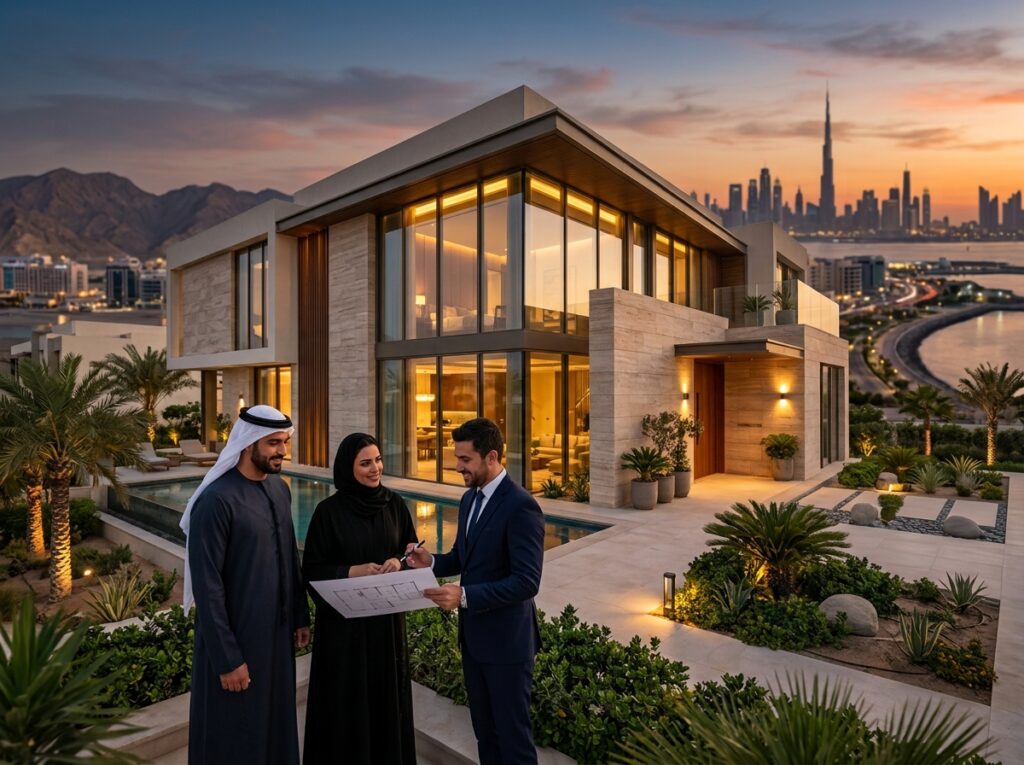
When you walk into a beautiful house, your brain naturally focuses on the things designed to impress you: a scent diffuser, styled cushions, music, a polished kitchen island, maybe a dramatic pool view. Enjoy it, but switch into buyer mode after the first two minutes.
Start outside. Look at the road approach, drainage, exterior cracks, roofline, garden condition, façade paint, parking slope, boundary walls, and any signs of water staining. In Gulf climates, sun, heat, dust, irrigation, and humidity can expose shortcuts quickly. A home can look new while systems behind the walls need attention.
Inside, move slowly and open things. Open cabinets. Run taps. Stand in bathrooms long enough to spot odours or poor ventilation. Check window seals. Look above ceilings for staining. Notice whether the bedrooms feel warm at midday. Find the electrical panel. Ask where the water tank, pumps, and AC equipment are located. You are not being difficult. You are doing what a serious buyer does.
For villas and townhouses, pay special attention to the outdoor area. Ask who maintains landscaping, irrigation, pool equipment, pest control, gates, and exterior lighting. An oversized garden sounds amazing until you realise it adds a meaningful monthly maintenance routine.
For apartments, study the building as closely as the unit. Check lobby condition, elevators, visitor experience, parking access, gym quality, pool management, maintenance response, service-charge history, and the view from common areas. A premium unit inside a poorly managed building can become a resale headache.
Price Is Only One Number: Create an All-In Budget Before You Make an Offer
This is where smart buyers get ahead. The advertised price is not your final cost. Your real number is the all-in acquisition budget plus the first year of living or holding costs.
Build your budget in five buckets:
- Purchase price and deposit. Know the reservation amount, contract deposit, payment timing, and whether funds are refundable under specific conditions.
- Transfer, registration, and authority charges. These differ by market and transaction type, so confirm the current official schedule before signing.
- Broker, legal, mortgage, valuation, and bank costs. Even a cash deal can need professional support. A financed purchase may add valuation, processing, insurance, and documentation costs.
- Community and operating costs. Include service charges, maintenance, utilities, cooling arrangements where applicable, insurance, garden or pool care, and furnishing.
- Your safety reserve. Keep cash for small repairs, move-in surprises, and the first few months after handover.
Do not let a seller rush you into thinking only about the monthly mortgage payment. You need to be comfortable with the down payment, the closing cash, and the reserve after completion. A home should improve your life, not drain every bit of flexibility out of it.
A useful stress test is this: if the air-conditioning needs a repair, your car needs tyres, and you have an unexpected family expense in the same month, can you still own this home without panic? If the answer is no, the price is too high for your current position, even if the bank says yes.
For investors, add another layer. Estimate realistic rent, not the highest number from a listing ad. Then subtract vacancy time, management, maintenance, service charges, furnishing refreshes, and financing costs. A property is not a strong investment because the gross rent looks attractive on paper. It is strong when the net result still works after boring, real-world costs.
From Offer to Keys: A Buyer’s Step-by-Step Playbook
Once you find the right Home For Sale, emotions speed up. This is the point where you need process.
- Get financing clarity first. Speak with lenders or advisers before you offer. Know your likely borrowing range, required down payment, documents, and timeline.
- Make the offer in writing. Keep it clear: price, inclusions, deposit, proposed completion, conditions, and who pays which costs. Verbal promises are not a purchase strategy.
- Verify seller authority and property records. Confirm that the seller can sell, that the unit details match the documents, and that any mortgage, lien, outstanding charge, or restriction has a documented path to resolution.
- Review the contract carefully. Make sure the property reference, size, fixtures, payment milestones, default clauses, completion date, and handover condition are written accurately.
- Arrange an independent inspection where sensible. Especially for resale villas, older homes, or anything that shows even minor warning signs. The inspection may not kill the deal; it may give you a better negotiation position.
- Do a final pre-handover inspection. Check that agreed repairs are complete, inventory is present, systems function, access cards and keys are provided, and no new damage appears after your earlier viewing.
- Keep every document. Save payment receipts, reservation forms, contracts, email approvals, inspection reports, title records, warranty information, and maintenance records in one secure folder.
The Dubai Land Department’s public data and directories can be a helpful additional verification layer for Dubai buyers, including checks around market information and industry participants. In every country, use the relevant authority and qualified local professionals to confirm the live details of your transaction. a Gulf Home Easy to Resell Later?
Nobody likes to think about resale while they are buying. Do it anyway. Future buyers will evaluate your home with the same practical eyes you should use today.
Homes usually hold buyer interest better when they have easy access, logical layouts, good parking, reliable maintenance, realistic running costs, usable outdoor areas, and a community that still makes sense for daily life. A massive villa with awkward rooms can be harder to sell than a slightly smaller one with a clean, efficient layout.
In the UAE, proximity to employment hubs, schools, established retail, transport routes, and a recognisable community brand can matter. In Oman, buyers may value a quiet coastal setting, mountain access, a well-managed lifestyle development, and uncomplicated upkeep. In Qatar, proximity to business districts, education, major roads, amenities, and a strong building or community-management record can carry weight.
Avoid paying a huge premium for a feature only a tiny group of buyers will want. An unusual themed interior, an overbuilt garden, a converted garage that removes practical parking, or a dramatic layout change can limit your resale pool. Personalise your home with furniture and finishes. Be careful with irreversible changes unless you genuinely plan to hold the property for a long time.
The Biggest Mistakes Buyers Make When They See a “Perfect” Home
The first mistake is buying urgency instead of buying value. Yes, good homes move. But a rushed buyer can ignore red flags just because somebody says another offer is coming. Ask for proof of the process, then proceed calmly.
The second mistake is trusting marketing language without documentation. “Freehold,” “guaranteed return,” “residency eligible,” “zero commission,” and “fully renovated” all need follow-up questions. A professional agent will not be offended by this.
The third mistake is underestimating the boring parts. Community rules, maintenance records, cooling bills, traffic patterns, construction noise, service charges, insurance, and parking do not make for exciting listing photos. They absolutely make or break the ownership experience.
The fourth mistake is choosing a house based only on today’s needs. Think two to five years ahead. Could your family size change? Might you work from home? Could you need to rent the home out? Will ageing parents visit for extended periods? The right home gives you some options.
Finally, never skip local professional verification because you want to save a little money. Legal and transactional costs can feel annoying until they prevent a much larger mistake.
Frequently Asked Questions About Buying a Home For Sale
Is buying a Home For Sale in the Gulf better than renting?
It depends on how long you expect to stay, your available down payment, your career stability, and whether the home fits your long-term plan. Renting can protect flexibility. Buying can give you control, stability, and potential equity. Do not make the decision based only on rent-versus-mortgage headlines; compare all ownership costs and your likely holding period.
Can expats buy homes in Dubai, Oman, and Qatar?
Expats can have property-ownership routes in these markets, but the exact eligibility, areas, and tenure structures differ. Dubai refers to foreign ownership in freehold areas; Oman regulates non-Omani ownership within ITCs; Qatar has designated areas and recognised freehold/usufruct pathways for non-Qataris. Confirm the specific property and current rules before paying a deposit. turn445944search4turn445944search11
Should I buy off-plan or a ready home?
Off-plan can offer new designs, payment-plan flexibility, and lower maintenance in the early years. A ready home lets you inspect the actual unit, community, view, quality, and commute before you buy. Choose off-plan only when you understand the developer, contract, handover timeline, and downside if the market changes. Choose ready when you value certainty and immediate usability.
What should I check before paying a reservation deposit?
Confirm the property identifier, seller or developer authority, title or tenure structure, deposit refund conditions, timeline, inclusions, payment destination, and contract next steps. Never send money to an unverified personal account because somebody says the deal is urgent.
How much cash should I keep after buying?
Keep enough to cover closing costs, basic furnishing or move-in work, and a genuine emergency reserve. The exact amount depends on your income and property type, but the goal is simple: owning the home should not leave you unable to handle normal surprises.
Does a property purchase automatically give residency?
Do not assume so. Some property-linked residence services exist, including Qatar’s official real-estate residence approval service for non-Qataris in designated areas, but eligibility, qualifying thresholds, documents, and benefits must be checked directly at the time of application. ghts: Buy the Home, Not the Hype
The best Home For Sale is rarely the loudest listing. It is the one with the right ownership route, daily-life fit, financial breathing room, clean paperwork, and a community you will still like after the handover excitement disappears.
Take your time where it matters: title verification, ownership eligibility, inspection, budget, and contract review. Move fast only after those pieces are clear. That is how you buy confidently in the UAE, Oman, or Qatar without getting trapped by a pretty brochure or a rushed sales call.
Ready to compare property types and spot the difference between a good listing and a costly compromise? Read our next article: House For Sale: What Smart Buyers Check Before They Book a Viewing.